
Isaiah prophesied the coming of the Messiah 700 years before the opening scene of today’s Gospel, and we hear in his words God’s promise to send a messenger before him, “a voice of one crying out in the desert.” St. Mark makes sure to draw the connection between what is happening and what was foretold by the Old Testament.
He tells us that St. John the Baptist is baptizing in the Jordan River, through which the Israelites had miraculously crossed to enter the Promised Land, and in which Naaman the Syrian had bathed to be cured from leprosy. His clothes are reminiscent of the Prophet Elijah, who was expected to appear before the Messianic age. The locusts on which John feeds are the only insect permitted by Jewish regulations, illustrating his faithfulness to Old Testament law. He has humbled himself with the poorest clothing and poorest food and poorest dwelling (subsisting on what was available) to make himself worthy of the mission he was born to fulfill: to announce the coming of the Messiah.
But John makes sure to proclaim his lowliness, saying that he is “not worthy to stoop and loosen the thongs of his sandals,” a task only fit for a slave to do; a slave would remove the sandals and wash the feet of travelers after their journey, dirtied by the dusty roads caked with manure. And John, the greatest of prophets and the greatest of those born of women, considers himself less than a slave. St. John is deeply aware of his place before the mighty Lord. He is not worthy.
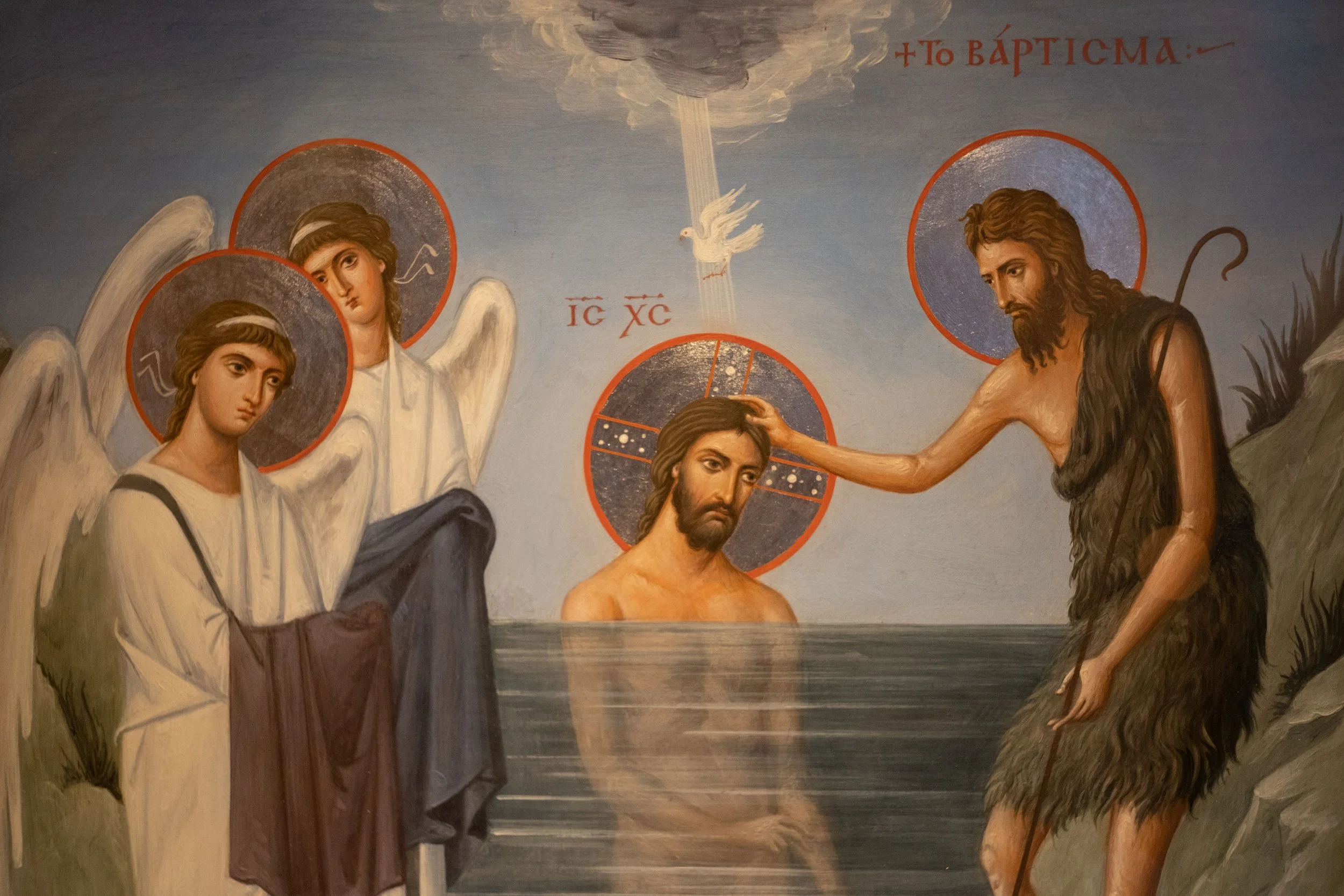
And yet, “people of whole Judean countryside and all the inhabitants of Jerusalem” trekked through the wilderness to acknowledge their sins and be baptized by him in the murky water of the Jordan river. This was a familiar ritual to Jews, symbolizing a ceremonial cleansing and repentance, a renewal of their spiritual life. But Jesus is coming to fulfill the Old Testament prophecies and rituals, as John makes clear: “I have baptized you with water; he will baptize you with the Holy Spirit.” John’s baptism is for repentance and preparation to receive the Messiah; Jesus will later sanctify the waters of baptism to forgive sins, give sacramental grace, and enable us to share in God’s own life.
Without the coming of the Savior for which we are preparing, we would remain less than slaves, unable to enter into the glorious life of the Trinity which Baptism opens up for us. As we pray and prepare to receive this little Babe at Christmas, let us also remember that he comes to rescue us from the sin that keeps us estranged from all that is good!